




Artist: Jacques-Louis David
Year: 1814
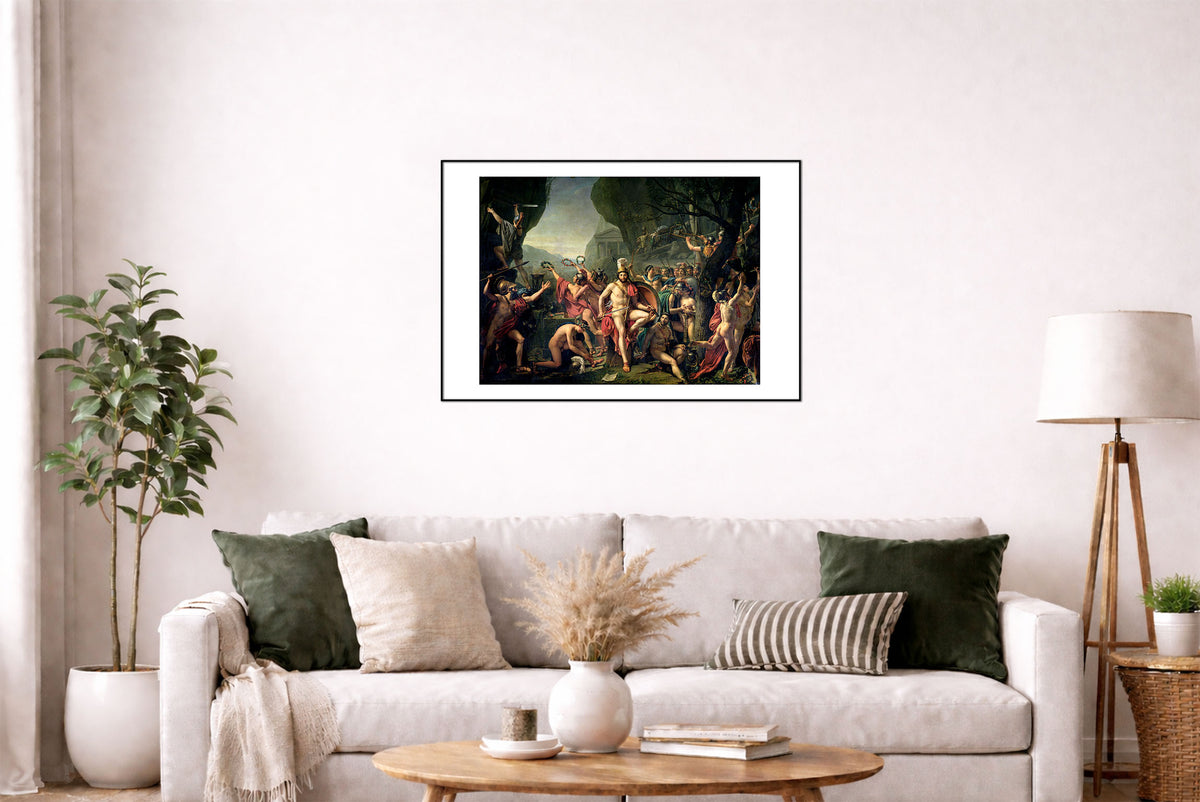
This is a reproduction print of the monumental historical painting “Leonidas at Thermopylae” (Léonidas aux Thermopyles), created by French Neoclassical painter Jacques-Louis David in 1814. One of the most celebrated representations of ancient Greek heroism, the artwork depicts King Leonidas I of Sparta and his warriors preparing for their final stand at the Battle of Thermopylae in 480 BC, during the second Persian invasion of Greece. The original painting is housed at the Musée du Louvre in Paris, France.
The composition portrays King Leonidas seated at the center of a group of Spartan warriors, surrounded by soldiers preparing to face the overwhelming forces of the Persian king Xerxes I. The Spartans are shown with their weapons, shields and helmets, while other figures embrace their companions or prepare for battle. Above them, a soldier carves the famous inscription associated with Thermopylae into the rock, commemorating the defenders' sacrifice. The scene captures the determination and discipline of the Greek warriors before their final confrontation.
David's painting is particularly remarkable for its monumental composition, idealized human anatomy, classical architecture and carefully balanced arrangement of figures. Inspired by ancient Greek and Roman art, the artist presents the Spartans as embodiments of courage, patriotism and self-sacrifice. Rather than depicting the violence of the battle itself, David focuses on the solemn moments preceding the final struggle, emphasizing the moral significance of the defenders' decision to remain at their posts.
Painted in oil on canvas, the original artwork measures approximately 395 × 531 cm. David began developing the composition years before completing it in 1814, during the final period of Napoleon's rule in France. Although popularly associated with the 300 Spartans, the historical last stand at Thermopylae also involved other Greek defenders, including Thespians and Thebans. The painting remains a masterpiece of French Neoclassicism and historical art, commemorating one of the most legendary episodes of ancient Greek and military history.